(Contains spoilers for Whiplash)
Seeing a film for the first time in a long while is a strange thing. I first saw Whiplash way back in May 2014 at Cannes, and proceeded to spend the next eight months shouting things like "it's amazing!", "a game-changer" and "that ending!" at anyone (aka no-one) that would listen. After a second viewing I can confirm that yes, Whiplash is still great. Only this time I found myself liking the film for reasons that I hadn't noticed before, reasons that I'm not even sure director Damien Chazelle meant to be in the film. Whiplash is a great film because it, just like last year's Nightcrawler, The Wolf of Wall Street, The Social Network, or even films as far back as Altman's The Player, states a fact that is obvious to all of us but that we politely deign to mention for fear of upsetting their fragile egos - if you are a middle class white man, there is little to nothing that will stop you from getting what you want, no matter how many people you have to manipulate, trample, rape or kill to get it.Why then, you may ask, does that make Whiplash such a good film? Aren't there enough films out at the moment about white men trying to reach for the American (or English, if you look to The Imitation Game and The Theory of Everything) Dream? Should I just go see Birdman or Foxcatcher instead? Well, let us propose something that has long been stated by theorists - cinema is a mirror that can be used to view ourselves and our society. Just like looking at yourself in a mirror after a long cry or a heavy night, it's not always particularly flattering. What do we see when we look through the cinematic mirror? We see a complete lack of diversity, and white men dominating the scene (both on and off-screen) just because they're white men. And another thing - cinema is supposed to be more than an just artform. Isn't cinema is a device to change the world? Has it done much changing so far? Hell no it, but maybe one day it will. So, the more films we make about the type of guy that saunters into a job interview, raises one eyebrow because he knows he's earnt it and ends up running the country within a year get made, the more we'll start to think that hey, isn't this a little problematic? Maybe we should question this, not just in our cinema, but in our society. It's worth pointing out as well that this is the inherent difference between films like Whiplash and Nightcrawler and films like Birdman and Foxcatcher - the directors of the former give us films filled (perhaps accidentally but nevertheless effectively) with the inevitability of white male privilege, whereas the latter try to convince us that oh, isn't life such a struggle for the white man? How will this famous actor manage to put on a play? Foxcatcher is a little different in terms of Mark Ruffalo and Channing Tatum's characters as there is actually a serious element of win or lose when it comes to wrestling, but the idea of the white American Dream is still there first and foremost.
A counter example of this is a film I haven't written about for a while, (so I'm going to be indulgent and do so here) Inside Llewyn Davis. Oscar Isaac's Llewyn is talented, and he sure as hell knows he's talented. Just like Miles Teller's Andrew, he treats people like shit because he thinks he's "better" than them due to his talent. So what's the difference between Teller's Andrew and Isaac's Llewyn? It's the colour of his skin of course. In reality, Isaac is Latino, and in the film he's Italian American. In one memorable scene, after F Murray Abraham's Bud Grossman rejects him as a solo singer, he offers him two pieces of advice for blending into the background and making it as part of a bland trio: "don't go in the sun, and shave your beard into a goatee". Due to his ethnicity, Llewyn's only option for stardom is to blend in and conform. Andrew on the other hand, can make it on his terms thanks, once again, to his established privilege.

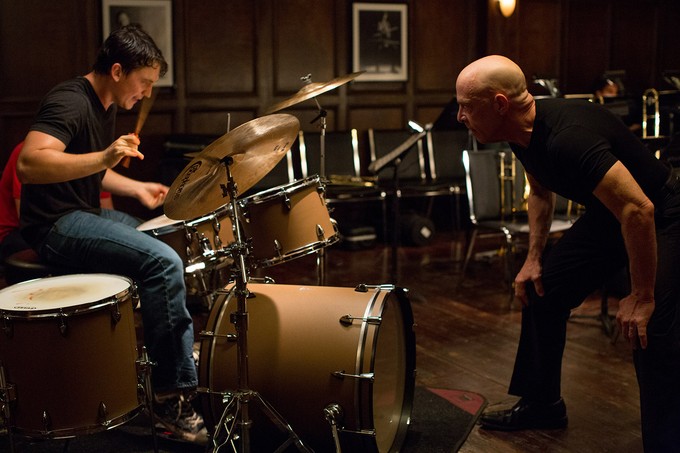
The last scene of Whiplash is a solidification of all I have been talking about above. Throughout the film we are lead to believe that Andrew is a big bright shining star, and while it's exhilarating to watch all the highs of his talent, its also a little satisfying to watch the lows. So when you see him be beaten yet again by his ex-teacher and antagonist, you think it's finally all over. Forget talent, it's all about who has the bigger balls, and who can pull one over on who. That is, until he comes back out onto that stage, and begins his tour-de-force, an ace class in how to manipulate people in order to get what you want. By forcing his teacher to go along with him and help him give the best performance possible, Andrew starts once again to ascend to the top. J.K Simmons's character in Whiplash is certainly not perfect - far from it in fact, he's a homophobic (pretty much all kinds of phobic to be perfectly honest) bully. But it's a little disheartening to see what was once such a strong character be completely pulverised by his protégée and turning into a smiling, encouraging put upon helper. But hey, that's just the way it goes isn't it? Just like the phoenix, you can only keep the privileged white man down for so long - it's their destiny to ascend from the ashes to restore the status quo of society.
Grace Barber-Plentie