
Music, and the suffering that goes with it, certainly seems to be the grand cinematic theme of 2014. As already mentioned here, thus-far all of the films released this year dealing with the trials and tribulations of troubadours seem to offer a very negative view of the industry. However Damien Chazelle's Whiplash, a frenetically paced dark-ish indie that was rewarded with the audience and jury prizes at Sundance seems to suggest that if your goal is to be the very best then you can, to quote Reggae legend Jimmy Cliff, "get it if you really want".
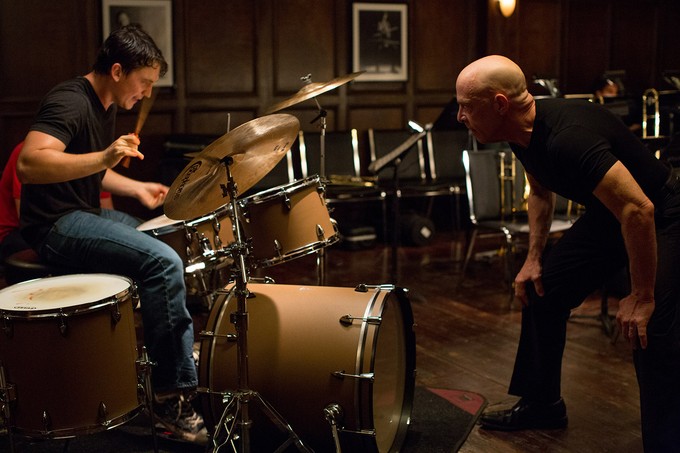
The film focuses on Miles Teller's Andrew, a first year student at music school who is determined to be the next big thing, thanks to his drumming skills. He lives a secluded life - his only suggestions of a social life are his weekly cinema trips with his father and subsequent awkward attempts at forging a relationship with the cinema's concession stand girl. (This "romantic" subplot is one of the film's few weaknesses, breaking up rather than enhancing the narrative and giving Melissa Benoist a few lines to add to her resume.) All of his passion goes into his drumming, seemingly for naught until he is selected by Terence Fletcher (an equally humorous and terrifying J.K Simmons) to join his prestigious jazz band, a springboard to any job Andrew could ever want. However what Andrew does not reckon upon before joining the band is Fletcher's dedication to making his band sound the best that they possibly can be - and the lengths that he will go to to achieve this.
While it's worth noting that its dialogue is nicely written - the highlights being Fletcher's wince-inducing putdowns that he regularly bellows at the members of his band - Whiplash's narrative doesn't really bring anything new to the table. But what truly sets the film apart from others about music is its camerawork and editing. Scenes of rehearsals are breathless shot, racing down the ends of trombones, cutting to sweat on the brows of focused musicians and bloody drumsticks clutched by desperate hands, barely giving the audience time to catch their breath. Whiplash seems to convey something different from the other musical melodramas of 2014 - it showcases not just the labour and suffering but also the success of being of a talented musician. The intimacy of the close-ups constantly used in the film is unexpected but works wonderfully as it seems to take the audience "inside" the music, rather than making them passively watch people watching a performance. The quality of the music in the film is exceptional - other than the scores of Woody Allen films or soundtracks to period films, it is a rariety to have a film that contains so much jazz music. It certainly makes a change from the moping indie musicians clinging to their guitars that we are used to seeing on the screen.
Another interesting feature of the film is the subjective viewpoint that it takes towards its main characters. We are never directly told that Fletcher is wrong for pushing Andrew to breaking point in order to get him to produce the best music possible - he can be viewed as an absolute psychopath toying with his students for his own amusement, or a genuine lover of music and a believer in perfection. Andrew too is a unique character as, similarly to Jesse Eisenberg's Mark Zuckerberg, he spends the majority of the film behaving like an absolute brat to everyone in his life, purely because he feels "better" than them due to his talent. (A scene where he insults the quarterback sons of a family friend for being popular but not "talented" is a perfect example of this) It is very, very easy to dislike him, yet when he plays, his superior stance can easily be justified.
With the great music-film slew of 2014 upon us, it would be very easy and unsurprising for Whiplash to go unnoticed compared to Oscar winning documentaries and films with Michael Fassbender in. But the raw passion of Whiplash and its protagonist easily sets it apart from the rest, making it a film that will completely absorb you, releasing you only when the final drums have sounded.
Grace Barber-Plentie
4/5

